
Recently I had a friend invite me to speak on a panel discussing a pretty basic and essential question: Why does Jesus Matter?
I suppose that as an Assemblies of God minister there is an expectation as to how I would answer this question. In fact, I dare say that those who invited me to speak on the matter invited me for just this reason. They wanted to hear a clear articulation of the traditional answer to the question.
My Assemblies of God argues that “Man’s only hope of redemption is through the shed blood of Jesus Christ the Son of God. Salvation is received through repentance toward God and faith toward the Lord Jesus Christ. By the washing of regeneration and renewing of the Holy Spirit, being justified by grace through faith, man becomes an heir of God, according to the hope of eternal life.” (http://ag.org/top/Beliefs/Statement_of_Fundamental_Truths/sft_full.cfm#5)
As far as it goes I have not one concern about this position, even though it has come under attack as somehow creating an image of a blood thirsty God who is simply waiting for us to mess up so that we can suffer eternal damnation. These critiques are simply misunderstandings and even a person with an undergraduate degree in theology can respond adequately: God does not desire to punish anyone but God’s holiness demands righteousness. This is not a limit on God, it is a fact of the very condition of holiness. We do not critique darkness because it is unable to accommodate the presence of light. It just is this way as an aspect of the very definition of the thing. And so the traditional argument that the importance of Jesus lies in how he is able to make it possible for unholy people to stand in the presence of God, by taking on their unrighteousness and exchanging it for his righteousness, is part of the message of the cross of Jesus. Jesus, being sinless and in fact even holy, did not suffer the death which is caused by his sin, rather he suffered the death of our sin in our place so that we may live life at its most full. Praise God.
But I simply cannot stop there. To do so would be a little like stopping at the narthex of a great cathedral because you had in fact, “gotten into” Notre Dame or St. Paul’s or the like.
My wife and I have a nerdy pastors’ tradition of making one of our vacation destinations a visit to the nearest cathedral to where we are taking vacation. Maybe the greatest that I have seen is St. Patrick’s in Manhattan but most of the great cathedrals share a common trait: the narthex is built such that when you enter it you are clear that you have not yet entered the greatest part of the cathedral. You can see rich imagery and form just beyond the narthex and you are drawn to keep walking past the narthex and enter the fullness of the cathedral.
I think stopping with the saving work of Jesus for you and me is a bit like stopping in the narthex. It is in fact part of the Gospel, but you and I are not the most important aspect of the Gospel story: God is.
If we were to rub our eyes a bit, as you do in the morning when you haven’t seen clearly in a while, we could begin to see the Gospel story’s significance is about the world which God has and is creating and re-creating. This story is significant not only because it includes the way in which each of us will enjoy God’s presence forever but more importantly because the Gospel is a continuous revelation of who God is independent from and yet imaged by God’s good creation. God made the world that he might enjoy it and that his creatures might properly enjoy him, but also because the way of the Gospel which is told in the story of God’s creation actually reflects the person and being of God. Do you want to know what God is like? Look at the story of creation and joy in the early chapters of Genesis. Look at Moses and the Exodus. Look at David and his salvation from both his enemies and his own sin. Look at Paul’s conversion on the road to Damascus. And ultimately, look at the redemption of all things in the final chapters of Revelation. That is what God is like. And if the story continues to play out as we are told it will, then we will all see the beauty of a God who makes in his own image.
So where does Jesus fit into this greater story? All of Christian theology deals with this question in one way or another. For brevity, I will function on only the two most significant aspects of Jesus’ ministry as window into the rest.
We cannot and should not ignore the cross of Christ in this wider and more expansive account of Jesus’ significance. Paul’s emphasis on preaching “Christ crucified” was central to his message, if for no other reason than its absurdity as a way of redeeming the world (I Cor. 1:17-31).
The cross of Christ is significant because it reveals to us our own sinfulness. Even the righteous man will not be spared the violence of sinners. When the truly righteous comes, his death will be the result of a conspiracy between political and religious leaders and even his own friends, all among those whom are expected to be the most holy in the community. Jesus crucifixion reveals to us the depth of humanity’s fallen nature. In the great sermons recorded in the book of Acts “whom you crucified” is spoken of as a word of judgment against those who conspired (Acts 2:36, 3:15, 4:10, 7:52-53). The cross by itself is not the glory of Christ, but the shame of sinful humanity.
The very heart of the Gospel lies in the second movement, “You killed the author of life, but God raised him from the dead” (Acts 3:15). Paul put it another way, “if Christ has not been raised, your faith is futile; you are still in your sins” (I. Cor. 15:17).
Why is the resurrection of Jesus so important? Because his resurrection is the “firstfruit” of our coming resurrection (I Cor. 15:20). When we read the end of the story, those final chapters of Revelation tell a story of God’s city coming down out of heaven to dwell among people. God’s presence no longer will live in temples, but will be among the people. And what will be the great indicator that this has come? There will be no more mourning or death or crying of pain. All these things will give way to the power of resurrection. A power whereby “death has been swallowed up in victory.”
Jesus resurrection matters because it is the first moment of the initiation of the new world. Everything changes on Easter morning.
These different aspects of the Gospel message do not need to be set against one another. There are even a great number of other ways of construing the importance of Jesus. Orthodox Christians would say that the union of human and divine is the beginning of our union with God. Some Christians speculated that Jesus was the “ransom” for a debt owed to Satan. And some Christians have argued that Jesus made possible the path to the righteous kind of life by first living the righteous kind of life.
These are not mutually exclusive. There are some ways in which one of the other might be construed which would be exclusive. Jesus as a moral example has sometimes been proposed as an exclusive because it has been suggested that Jesus was necessarily human to the exclusion of divine. This is a problem for Christian orthodoxy. But most of these other proposals are parallel and not contradictory.
But I do think it matters which of these we try to articulate. The message that Jesus forgives us of our sins because of his sacrifice on the cross is important for persons seeking their life to be reconciled to God. This is the reason that this aspect has been told so many times.
But the proposal that I have just suggested has audiences which are drawn to it as well. Viewing Jesus this way means that you can affirm the place of the world in God’s plan of redemption. It means that you can account for the gross injustices in the world with hope that God cares and will do something about it. If the Kingdom has begun, it can also mean that we have some hope that small pockets of Christians may overcome injustice, even if only temporarily, as a sign and witness that God will finally defeat death in an overwhelming and final victory. That is Good News. And Jesus matters because his story is Good News.
The Tension of Gray
I had a friend ask to write a blog entry about how I understand interfaith relationships and the future of interfaith relations. His blog can be found at: http://uindyinterfaithforum.wordpress.com/
This is my humble response:
Thirteen years ago I walked into a banquet hall with a 12-foot suspended ceiling (the kind you see in hospitals and grade schools) and completely bare walls. It was once a roller-skating rink, but this night it had been transformed into a worship space. I mean, I guess it was a worship space, but it looked more like a rock concert. Huge guitar amps and a 9-foot high wall of speakers told me that this wasn’t like the non-instrumental Church of Christ that I attended as a young boy. When the room filled with more than 500 teenagers jumping to the lyrics “I believe, I believe!” I knew something was about to change in my life.
Within about three weeks, I realized that this was a radical group of Christian disciples. And my life was never going to be the same. It hasn’t been the same.
About seven years ago, I had another life-changing experience. This time it was a small chapel with a couple dozen college students. There was incense and statues and brightly colored robes with a priest who spoke in a slow and monotone voice. He spent the next hour or so explaining each element of the Roman Catholic Mass. He told us about how the multiple readings of Scripture pointed to the importance of the whole Bible. He explained about how the Eucharistic prayer recounted a summary of the whole of salvation history. And then he handed out little wafers and a quick drink of wine and told the group gathered that Jesus was present in those humble gifts: and he meant it.
But I had long thought that Roman Catholics had hidden the truth of Jesus Christ among their stylized rituals. Suddenly I realized that the faith I held so dear was at the center of those rituals. After talking with a few Roman Catholic friends, it became clear to me that life was never going to be the same again. It hasn’t been the same.
Not only did I discover that I had been sorely wrong about the faith of my Roman Catholic friends, but I began to realize that I may very well be wrong about a great deal of other things. But you simply can’t live that way. You can’t walk through daily life without some idea of how the world works and what your place in it is.
So I made a pledge. I cannot dismiss the religion of another as foolish. And I must not give up the faith I hold so dear as I explore life and faith and truth with those who see things quite differently than I. Those notions were formed in the context of a Pentecostal Christian learning from Roman Catholic Christians. But the tension between these two commitments doesn’t stop at the border of confession of Jesus.
The tension between learning from the Other and holding on to the faith which gives you life and hope can never be resolved easily. And the generation who I serve as a University Chaplain at UIndy is ready to fully explore a world that is marked by shades of gray. I think that the future of interfaith relationships is going to be marked by these two realizations.
People in the emerging generation have eaten at table with Muslim, Buddhist, Christian, and Wiccan. Some of the beliefs and commitments of these folks strike them as dead wrong. On the other hand, I don’t know very many Christians, even those who count themselves among the radical Christian disciples, who have a prayer life which equals the prayer lives of their faithful Muslim friends. We have some things to learn from each other, but some of our differences go down to the core of who we are and will never be reconciled.
Dismissing the Other without questioning your own beliefs and practices is too simplistic. The problem is, you might be dead wrong: just as I was about my Roman Catholic friends.
But giving up the good gift that God has given me as a Pentecostal Christian denies the gift that I have to offer the world as I pray for healing and I live for Jesus. If I give up my commitment that Jesus is “the Way, the Truth and the Life” to pretend that we all worship the same God, then it seems that I have little to bring to the conversation and little hope for my life or theirs.
There must be another option: one that is filled with ambiguity. But the ambiguity encourages a life where faith is the “evidence of things not seen.” It takes a mature and faithful person to raise their hands to God in worship and be fully aware that another faithfully religious person thinks you are deeply mistaken in that act of worship. These are things that you discover when you refuse to let these difficult questions at the intersection of faiths be resolved with bumper-sticker theology.
This generation of faithful leaders will not be so easily charmed by images of a black and white world. And I think their commitment to God will be better for it.
She Said Yes! Why Mary’s Yes Makes Her A Model For Us All
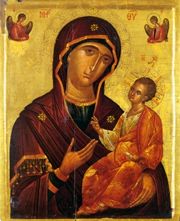 “I am the Lord’s servant,” Mary answered. “May it be to me according to your word.” (Luke 1:38)
This statement is the primary reason that Roman Catholic Christians give such high regard to Mary, the mother of Jesus. The situation was obviously a terrifying one. Engaged to be married and met by an angel who gives word of her pending motherhood. Surely no one would believe the story of an angel’s message of her conception of a child. Would they? [Read more…]
The High Priest and the Highest Sacrifice
I was reading Hebrews today and I was struck by the imagery which is central to that book. Jesus is not only the High Priest which represents the people of God to God. He is also that sacrifice which he himself gave over to God to make atonement for the sins of the whole world.
Some of my more left-leaning friends have a real problem with this imagery. Is God just a blood thirsty warlord desiring violence and vengeance upon God’s people? Doesn’t God have another, less bloody, way?
I suppose that God has any way open that God desires. While I really like Anselm’s “Why God became man,” I’m not convinced that this is the only way that God could bring freedom and love to the whole world. God could have done it another way. God is a creative and powerful God. I suppose that God’s choice to do it this way and not some other is even more profound than Anselm’s proposal. (Anselm, for a little refresher, said that God had to become incarnate because humanity owed honor to God that only humanity could pay [i.e. the wages of sin are death], but only God could afford. Only God was righteous enough to be the holy debt payer. Thus, the incarnation.)
If God could have brought hope, healing, and restoration in some other way, why this one?
I think it is because God had indeed chosen to bless all of creation through this one people, the Jews (Genesis 12). God blesses Abraham to be a blessing. So when God’s patience with human sin and disobedience grew to the fullness of time, God acts decisively in Jesus of Nazareth. God becomes incarnate to take on the consequences of the truly righteous life. While the previous sacrifices bore the weight of sin in a kind of ad hoc way, death at an altar, this sacrifice bore the actual weight of actual sin. People could not bear the conviction which comes from perceiving the truly righteous One. So when sinful people enter the very presence of the Holy, they kill Him. The Jewish people needed to see God’s love poured out in a language which they could understand. The language of sacrifice made sense to them. They could understand the unblemished being given for the sake of the blemished. It was a picture of grace. And so God moved in that way and not some other.
God could have given some other way, but why would God move in some other way when the Way was established by the history of a people to go this way. Ironically, the theology of St. Anselm was also this kind of contextual explanation of faith. Anselm used categories of justice and honor that were particularly persuasive in his medieval feudal context. That doesn’t make them bad theology, it just means they are a new contextualization of God’s saving action.
What would a 21st century contextualization of Jesus’ work look like? What does it mean that Jesus is our High Priest and Highest Sacrifice?
Our contemporary society sees the collective sin of nations and ecclesial bodies and longs for a group which will not primarily look inward. We see the sacrificial action of a generation led by rock stars to do justice in AIDS-ridden Africa and we are inspired. Why? Because so much of our experience tells us that people can simply not be relied upon to choose the other. Darwinism and Nietzsche have, in their own ways, told us that the most healthy thing a person can do is look out for themselves and get the most that they can for themselves and possibly their clan. These pervasive ideologies have turned the Christian doctrine of sin on it head (which is explicit in Nietzsche’s Genealogy of Morality).
The royal priesthood and holy nation which Jesus gathered around himself were not priests in the sense of killing animals for the sake of the community in the temple. This priestly community, like Jesus himself, gave of themselves for the sake of others. One of the things that is saving about Jesus in the 21st century is the calling he placed on the community who followed him to give themselves in love and service to others. He gave a community a vision of the future which did not bind them to the success of their ability to reproduce or their initiating the “will to power.” This community follows Jesus’ model of self-giving, knowing that the rewards of secular striving will not endure as the new heaven and new earth will. God will have the final word, as the resurrection proves. We are called to be both priests and sacrifices, just as Jesus was.
I dare say that this kind of community will speak to a 21st century Western world what Hebrews spoke to a first century Jewish one or Anselm spoke to an 11th century Medieval one. God’s work as High Priest and Savior is not limited to a paradigm of any particular period. If Jesus truly saves universally, then he will save us from our current sin and trappings as he did first century Jews from theirs.
He is a Good Savior. He is our High Priest. He gave himself as the Highest Sacrifice.
We are called to be Good. We are called to be priests. We are called to give ourselves as sacrifices.
What does a "just" war mean?
I have heard some pretty positive comments come back from Obama’s speech in Oslo at the Nobel Peace Prize ceremony. I don’t disagree that it is basically a good speech. But there are two important things that need to be said. First, nothing he said there should surprise anyone. Second, he did not address the most difficult concerns with his own proposal.
Now I think that my Christian identity calls me to a different kind of life that precludes supporting war under nearly any circumstance including threats to me and my own family and country. On the other hand, I don’t know that I could ever truly live up to what God has called me to in the midst of the most striking challenges to this ideology. Pacifism is, by all means, more difficult than responding with war and takes more courage. I’m just never sure that I can do it. Something that goes deep down inside of me, placed there by God when God spoke life into creation, is a desire for justice and the will to fight for it. But this post is not about me.
I don’t think that a nation can ever live by this Christian calling, though I would hope that ours could entertain it at the very least. Nations are formed on the basis of protecting their people. As Obama says in his speech, Ghandi and King may be great thinkers but their peaceful protests would not have stopped the advancing Nazi armies. Darfur. Rwanda. Congo. I don’t think peaceful protest will be effective at stopping these atrocities, even if my Christian faith tells me that peaceful protest is the right thing to do. Nations must protect from these injustices.
The rules for engagement are and always have been the rules of “just war.” Obama’s speech should not surprise us because all he did in the first half of his speech is reinforce the principles of just war: proportional response, just cause, combatant distinction, last resort, legitimate authority (which Obama aludes to by referring to leadership being tempered by not being a lone ranger).
Now those may surprise us now because they are talked about rarely. But they have been implicit in all but the most recent American war. (Danger must be imminent. Bush presumably thought there were WMD’s which would POTENTIALLY constitute imminent danger. I happen to think that even the presence of WMD’s would not have legitimate a preemptive war according to just war criteria, but that is debatable.) Obama is simply calling us back to adherence to these criteria. No politician present at his speech would have missed what he was doing.
Now, the weird thing that we heard from the media here is that this was some kind of defense of just war. I know PhD students are not supposed to be simple-minded but the only answer I can come up with is “Duh”. Every nation worth it’s salt would make a defense of just war, because that is the best alternative that can include war of any kind (thanks for the inspiration Switzerland). Defending just war is not a shift in government policy. In fact, just war criteria being followed will mean that we are in less wars, not more.
Now the problem is that just war doesn’t work in the postmodern environment. He doesn’t really address this at all except to say that we will need to rearticulate it. Well, to Mr. Obama I say, “Duh”. It is recognized among just war scholars that the criteria are outdated in the contemporary setting.
How do you have legitimate authority when your opponent is a terrorist cell? How do you have combatant distinction when your enemy is primarily civilians or dressed like civilians or using civilians as shields as in most urban warfare? Terrorism is, by definition, founded on ALWAYS placing the notion of imminent attack at the fore. Yet, you can never identify when a real threat is imminent (except in periodic CIA type operations but never in war operations).
One of the key proposals which Obama suggests for a “just peace” falls prey to a similar problem. How does he plan to sanction these types of cell groups? Can you starve out the small number of people with enough ammunition to steal the food they need and no concern for the health of their neighbor? I doubt it.
Obama’s proposal is not a total bust. The just war proposals and the peaceable solutions he advocate may actually work with North Korea and Iran. Let’s hope so. These are the kinds of cases that the rules were made to address.
I do think that just war is a viable dialog in the era of postmodern war. I don’t know what that would look like. I do know that Obama has not gotten to the heart of the concerns. I also know that the church is called to help politicians think through these issues. For generations she would have been looked to for help. Those days are no more. And this is one of the times when I can only be dissatisfied with pacifist friends (am I a pacifist?). That cannot help the government think through just war when government needs them the most. Maybe they will weigh in with a word about how or if they imagine themselves serving the government with guidance. Of course, she is always called to prophetically speak peace and justice. But can she also share wisdom on war? If she is Catholic or Lutheran I suppose she can. If she is Mennonite then I doubt she can.
Disordered Love: What St. Augustine Would Say About the American Health Care Debate
 The recent health care debate has a lot of people up in arms…why not talk about that…
OK, so I don’t really want to talk about that. I want to talk about sin. But the health care debate is what has gotten me thinking about sin. [Read more…]
The New Art
The people of Caedman’s Call have always been among the more brilliant artists in the Christian community. But Derek Webb has gone to a whole new plane after leaving that band for a solo career.
Now he has created some of the best art the Christian community has seen in some time.
Here is my short narrative of how the thing developed.
Several months ago, Webb wrote an e-mail to his e-mail list saying that his latest album was simply too controversial for his record label. He hinted at how he was going to have to do something risky and off the radar. So then he sends out another e-mail with the address of another website coded into the message. When you went to www.paradiseisaparkinglot.com you found a set of instructions to chase down little 2 second stems of the song that apparently got him in so much trouble with his record label. These song stems were on flash drives at coffee shops and such all over the country. When they were found, they were uploaded to the website for everyone to see. My friend, Chris Marchand, managed to get one of the ones that went to Chicago. They just released the last stems, which are available at shanebertou.wordpress.com in there completed form…give it a listen. Along the way, there were other links coded into the website and other places for people to download a few songs. All in all, it was giant easter egg hunt that took people literally all over the country and all over the WWW to find his music in what he said was a giant attempt to thwart his record label.
If you ask me, it is beautiful. Webb has done the marketing genius thing once before. His first album was shunned by many radio stations and Christian bookstores because he referred to himself and the Church as the whore of the book of Hosea. Clearly a traditional biblical allusion, but it was too much to use the word “whore” for the “Lord, I lift your name on high” crowd of CCM’ers. Later he released one of his albums for free download if you gave him the e-mail address of five friends that might also want to download for free and give him five more addresses. After about a month of that, he sold his album in stores. Sales of all his albums shot up from basic obscurity and he was getting interviewed by newspapers in Nashville for the stunt. Of course, other artists have done it since then. But Webb was among the first.
Personally, I think the whole thing was a hoax. If you listen to the song, it is clear why his Christian label did not want to sell it. He is touching on some hot button issues and calling some people “sinner” that aren’t ready to be called that. But, I have a hard time believing that releasing the album for free via little 2 second flash drives and Internet downloads is any more legal than just releasing the album independently. Shane Bertou’s blog (linked above) called it performance art, and I would have to agree. We should not be surprised that someone who is such a good artist musically is also a great marketing person. Marketing is the most prolific form of art in our generation.
The more pressing question that will arise will be from the controversy and the discussion in the blogosphere about this song.
The gist of it is this:
Out of the heart, the mouth speaks. Too many Christians only speak about homosexuality. They don’t speak about the tens of thousands dying of malaria and AIDS every year. They must not be real Christians because sexuality matters more to them than people dying.
On one level, I agree with him. A whole host of other emerging church types think that this kind of judgment is at the heart of the whole movement. Two things are in play here. First, we should not be letting far right politicians set the Christian agenda. These politicians have ignited a nearly dominate evangelical movement by making Christianity about who you sleep with. Don’t get me wrong, Christianity has a great deal to say about who we sleep with, but that isn’t the point of Christianity. We cannot let the agenda of a particular political group set the mission of the Christian Church, which is primarily about proclaiming and working towards the coming Kingdom of God.
Secondly, even though Christianity has some things to say about proper sexual relationships, the way that some Christians have been saying it is not helpful to Christianity or the people they are speaking to. The medium is the message. Many have made the medium of communicating the Christian way of life a hate-filled string of thunderous accusations and fear-mongering. And, the same group of people seem to assume that this is a really easy issue and the lines are black and white. I don’t think very many of them have had actual relationships with homosexual people who are trying to be faithful Christians. There are a great deal of them, though most of them eventually give up on Christianity or join churches that are so leftist and marginally Christian that there homosexuality is a non-issue or even a cause for martyrdom or sainthood. That isn’t all of them. I have several gay friends who have refused to give up their evangelical form of Christianity, and can’t see themselves giving up their homosexuality either. I think they would all agree that this can be a torturous place to be (though I haven’t asked them this specific question).
I understand what Webb is saying. Most of the emerging church types are saying the same thing. My question is whether this is an either/or proposition. Do we have to change our sexual ethics if we are going to fight against poverty and sickness in Africa? It doesn’t seem to be a necessary choice. Furthermore, it doesn’t seem obvious to me that the only way to love homosexuals well is to suggest that this is how it is suppose to be. Perhaps the Church could love them better by journeying with them in their day to day trials. In fact, it may be that this is all we are to do in the struggle against disease and poverty and every other social ill. We are to be friends of those who are hurting. Sometimes this may mean bringing antibiotics to a malaria stricken nation. Other times this may mean we have to defend our gay friend’s right to be in the hospital room when their long time partner needs them most.
I pray that I might be called a friend of sinners, just as Jesus was. If that means I am accused of being friends with homosexuals or even Derek Webb, then I am ready for that. Somehow I have to hope that means that people will see something of Jesus in me and they will point and say, “That is what God is like. That is what it means to be fully human.” That is the incarnation of the Body of Christ.
Back to Mr. Webb: He is a brilliant artist. He happens to read a lot of the theologians that I read, and I like that. But, I am not sure that the either/or choice he implicitly presents us in this song is anything like the third way that Jesus proposed. Maybe it is just one more start to a leftist politics. Certainly the current strain of leftist politics is just as bankrupt as the current strain of the politically right. Maybe we can still understand God’s design for humanity to be sexual love between a man and a woman, and yet be willing to honestly stand with our gay and lesbian friends in solidarity. Maybe we don’t have to yell and hate in the process. Maybe those of us of a Pietistic bent can get motivated to make a difference on societal sin in the same way we do personal sin. Certianly the Pietists and early Methodists from whom most of us have inherited our spirituality had no problem putting away alcohol for themselves and trying to teach the poor how to read and write.
Enough for today. I challenge you all. If you want to see good modern art, then trace out some of the Derek Webb links I have given here…and see what has happened in the last few months. Fascinating. And give your comments back here. I would love to hear what you think.
 Dr. Jeremiah Gibbs