This sermon was for the opening worship of our retreat for incoming freshman at the University of Indianapolis.

Theologian and Pastor who thinks out loud.
This sermon was for the opening worship of our retreat for incoming freshman at the University of Indianapolis.
I rarely enjoy a wedding as much as I did the wedding of Phil and Kelly Hassman. Part of it was my relationship with each of them. Kelly was one of my first students when I started teaching at the University of Indianapolis. She isn’t like every other college student. She speaks with depth and conviction about her commitment to Jesus. And she makes these terribly grounded  decisions well beyond the maturity of woman in her early 20’s. She is the kind of young adult that makes you ready for where the church is heading.
She married this brilliant young man that I have had the joy of sharing life with for these last four years. Phil is one of the rare students that understood a call on his life to minister to me even as I ministered to him. His smile blesses me and his difficult questions challenge me. To think of these two amazing young people in mission and witness together is a hopeful thing.
But the pure joy that I get from my friendship with these two wasn’t the only reason that this weekend was so special for me. Both Kelly and Phil were commissioned by the Lantz Center for Christian Vocation that I serve as director. The climax of this formation process is a commissioning service just before they graduate in which I and my chaplain colleague, Lang Brownlee, wash the feet of the commissioned students following the example of Christ and calling them to follow Christ’s example as well.
I have washed both Kelly and Phil’s feet. I don’t know if they have ever washed one another’s feet. But I know that both of them have washed other’s feet both literally and spiritually many times. All of the high school students from Herron High School’s YoungLife, where Phil and Kelly serve, was a great testament to their commitment to service.
The pastor that married them, Jeff Krajewski, brought the image of foot-washing right to fore of their wedding. He challenged Phil and Kelly that one of the greatest ministries that they can have will be the proclamation of Jesus’ Good News as they wash one another’s feet. It will be the ground of their marriage. And their service to one another will tell us all something about Jesus’ love for the Church.
I haven’t had a chance to talk with Phil and Kelly about what was going through their mind as he talked about washing feet. I suspect that they were thinking a great deal more about the person that they were about to marry and wondering what they looked like as they stood in front of those several hundred people gathered. But I’d like to think that as Jeff challenged these two with the Gospel that is both embracing them and calling them to a deeper life, they were remembering the times when they have stooped at another person’s feet, washed their feet, and carefully wrapped a towel with care and compassion.
The call that Jeff gave to Phil and Kelly was also a call for me and lots of other pastors that the mundane things that we do to form persons….eating bread, drinking juice, serving soup, saying the Lord’s Prayer, memorizing Scripture, confessing sins, and washing feet…may come back into their lives as the most opportune time. Don’t forsake the disciplines of the faith, because washing feet may be the best way to learn how to model Christ love for the Church.
Related Post:
Learning To Wash Feet: Reflections On A Wedding Gone Right
Now I don’t think I am prone to unnecessarily shy away from this issue. I have often told people that I think abortion should be illegal except in cases or rape and incest. And I’m still theologically working through even this exception. I don’t have a problem with the reflection offered for this day, except maybe pairing Cyprian’s comments on war with a reflection on abortion without explaining the contrasts.
But our normal mode of operation as an ecumenical campus ministry is to avoid emphasizing where various strands of Christianity would differ on an issue. We fully recognize that there are theological reasons for a variety of positions on this and other issues. Individual members of our staff might speak out on one or another of these positions. But rarely would we address these topics in worship because we hope for the worship that we organize to be a place where all Christians can gather together.
But that is one of the great formative aspects of “praying with the church.” That phrase refers to the practice of praying through a set of prayers and times that are handed down from the tradition. These prayers in many cases have been used for generations or even centuries within the life of the Church. In one sense, the practice of preaching the lectionary, the three year cycle of prescribed readings for worship, is another instance of this. Praying with the church describes a prayer life that is submitted to the Church’s tradition of prayer rather than following only the whim or desire of the individual who prays.
And this tradition will often bring us to those Bible verses or prayers that we would otherwise not read or pray. It brings us to those verses about money and judgment and purity that we would prefer to forget about. And causes us to say prayers of commitment and allegiance to those callings from God as well.
Many of us would much rather read just those parts of the Bible that suit us. We would rather pray in the way that is most encouraging. We want to practice those spiritual disciplines that are most comfortable. But to pray with the church says that maybe there is a more holistic way of being a disciple of Jesus. And if only I will pray along with the great tradition of prayer that is forged over time by a great many disciples under the guidance of the Spirit, then maybe I will become a fully formed disciple yet.
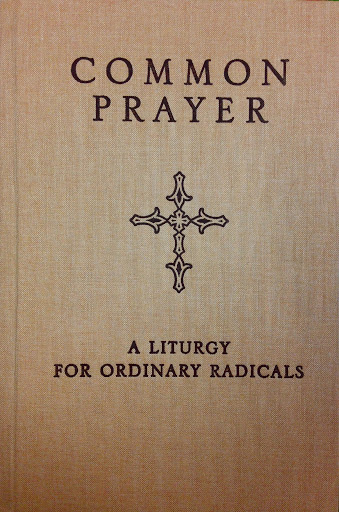
While I really like the prayer book that we were using (Common Prayer), I would really encourage you to find out what prayer guidance is offered from your tradition. Do you have a prayer list that is published by your denomination regularly? Do you have a daily liturgy and lectionary such as the Book of Common Prayer? Are you willing to submit yourself to the great saints of your own church to let them lead you in prayer? Do you trust these saints that much?
If you don’t have something like this in your tradition, then I would recommend the Book of Common Prayer’s Daily Office Lectionary that is available electronically here.
You can also get a hardback copy of the Book of Common Prayer very inexpensively.
I also highly recommend the book mentioned above, Common Prayer (by ShaneClaiborne, Jonathan Wilson-Hartgrove, and Enuma Okoro).
Related Post: Words of Grace for Inadequate Christians
If you like what you have read on this blog, please follow via e-mail or Facebook at the bottom of this post or via RSS feed from my home page.
The American Church is pretty anxious about the failure to reach young adults with the Gospel. As I enter my fourth year as University Chaplain at the University of Indianapolis, I have just a few reflections on my rather successful, but unremarkable ministry.
Our United Methodist-related university is very supportive of our work in campus ministry, but our student body is not any more Christian than the state universities in Indiana. I like it that way. I do ministry among regular college students. And God is doing something among those students.
I hope that my reflections, which are quite personal, will be helpful to some pastors out there who are trying to serve these everyday college students well.
I try very hard to not be cool. This isn’t particularly difficult for me. I was born “not cool” and I will probably retire even less cool than I am now. And I think my students would rather not see me with bleached hair, thick-rimmed glasses, and screaming guitar. I think they want me to speak slowly, listen carefully, and resist the temptation to shout platitudes and oversimplify the complexities of life and theology.
The most valuable ministry that I have done is listening to young adults talk about their dreams. I often go the extra step to put an opportunity before them that I know will form them into deeper discipleship (summer camping ministry staff, short-term missions, a seminary catalog, etc.). I eat a lot of meals with them–slowly. I ask them what they believe about complex theological concepts, and then I challenge them without trying to correct them. Not very flashy. I know you are disappointed.
I have almost completed my Ph.D in Theology from a major seminary (All But Dissertation). But I haven’t won these students by brilliant teaching. I suppose I may be a slightly above average preacher. Because our campus ministry creates lots of opportunities for students to preach for the first time, I don’t even preach that often anyway. I don’t dazzle them with powerful lectures or even book studies on great books. Most of the bible studies that I do are really just reading a single book of the bible really slowly. We read Ephesians through a semester and Hebrews for an academic year. We are reading Romans now and will take a year for that one. We ask hard questions of the text and then together struggle with what the text might be saying and how it might be calling us to live. But I do refuse to let the simple answers offered by those on the right and the left to go unchallenged. I refuse to get anxious about those who disagree with me. I trust that if God is real then I don’t need to change anyone’s mind…the Holy Spirit will do what is necessary much better than I.
I don’t preach something innovative. But my students seem to find the story I tell to be compelling. I simply talk about the power of the resurrection in everyday lives. I talk about the suffering of Jesus that was reversed by the power of the resurrection which promises a time in which all suffering will come to an end by the return of the King. I challenge them to join the story by fighting injustices across the globe and in our own city. I challenge them to witness to the truth of the Gospel without the anxiety of having to convert the whole world. The Holy Spirit will do what is necessary much better than them.
I challenge the places in their lives where I see inconsistencies (either with themselves or with the Gospel) and I give them confidence that our relationship is not dependent on accepting my challenges.
I’ve made mistakes. I’ve hurt a few students with things I’ve said these last few years. I always try to own the parts that are my fault and ask forgiveness. Others have simply not liked me. I’ve tried not to let those folks make me insecure about my work as a pastor.
I haven’t done a whole lot that is impressive. But I have seen that my students love me and trust me. They invite me to be part of their illnesses, their successes, and the decisions that determine their futures. I thank God for this opportunity. They don’t trust me because of my guitar skills or my hair style. But they do trust me to lead them toward the deepest kinds of discipleship. I imagine that 20 years from now they will not look back and see me as someone who changed their life.
I’m not suggesting that we minister from mediocrity. I hope that isn’t what I am doing. I’m suggesting that really excellent ministry is done every day by compiling a series of otherwise unremarkable but terribly consistent acts of ministry and discipleship.
Here is the Good News: if I can do this rather unremarkable ministry then so can you. Nothing I have done these last three years is something that any pastor couldn’t do among young adults. They are dying (spiritually, if not literally) for someone to authentically follow Jesus with transparency in close enough proximity to their lives for some of it to rub off. You can do that too. Just put the Gospel on display by serving students well
Maybe some of the young adults that have found my unremarkable ministry compelling can share some of why they have done so. Maybe they can teach us how to minister to them well. Add some comments that will help other pastors reach young adults.
In the last couple days, the following blog post about on occasion of church discipline at Mark Driscoll’s Mars Hill Church has gotten a lot of attention.
Mark Driscoll’s Church Discipline Contract
I think a great deal could be said about whether the author has given Driscoll’s church a fair assessment or not. One of my friends mentioned that the author sounds downright gleeful that he has finally caught Driscoll in something so obviously wrong. I’m going to give Mars Hill the benefit of the doubt here and do my best to assume that the author was not generous. I actually hope that the author has exaggerated the case for the sake of this person whom the article is about.
I definitely think that the church made a giant mistake here. The problem is that it is very difficult to explain the ways in which they did it wrong by speaking strictly of the facts. And yet I think I can still say that they got it wrong even from a distance and only having the story from the one who was offended.
I’ll come back to this.
I think the problem is that church discipline is a practice. And, like so many other traditional church practices, it has so fallen into disuse that even when it is picked up again it is usually misused.
I shared this analogy with some students recently. Think about the practices of certain sports. For example, consider the precision required to hit a baseball. Something as small as 1/2 inch different placement of the bat is the difference between a pop-up foul ball and solid contact. The difference between a ball that simply enters the field of play and one that is well hit (a home run?) is such a small fraction of an inch that I’m certain that I couldn’t explain it. Very minuscule differences exists between baseball swings in which the balls land in very different places. Now a very experienced hitter or coach is able to help a hitter refine what they are doing so that they do in fact make changes of just fractions of an inch to improve their contact.
Now imagine for a moment what would happen to a baseball player who was trying to hit without help from someone with experience. Maybe you had such an experience the first time that you picked up a baseball bat, tennis racquet, or golf club. The resulting hit was likely no where near where you wanted it to land and you had no idea even what you had done wrong. In fact, if you have truly had no exposure to a golfer who drives a ball several hundred yards down a fairway then you likely will not even know that your rolling the ball 100 feet is not a great accomplishment.
This is the problem with church discipline. The practice has so fallen out of use that we struggle to even recognize when it has been done rightly.
I’ve not been a part of a church when they disciplined someone well, so I can’t give too much advice. But I can confidently name what the proper aims of this practice should be: reconciliation with God and the church.
Now part of the problem with naming this church’s mistake is that at least in word they understand this is the goal, as evidenced by the consistent references to a person returning in repentance.
The best I can do to explain their error is this: if the pattern that you have established provides many ways that you can find your way out of the church and only one way that you can find your way back into good standing, then something has gone awry. And if the pattern that you have established has a big and wide path towards repentance and reconciliation, only continuing in sin and rebellion should be the path to find your way out.
The church further highlighted their malformed practice when they continued to try to control this person, and even more importantly others in the community, after he had left the church. I actually think that a letter telling the church (vaguely) what had happened would be appropriate, as well as explaining the rationale of the leadership. But to suggest that members of the church would be setting themselves in opposition to their pastoral leadership if they do not respond “as if he were an unbeliever” is a mistake.
How do we treat unbelievers anyway? Do we refuse to eat meals with them unless they will listen to us talk about repentance? Of course we don’t. Neither should treating a disciplined church member as an unbeliever result in this treatment. Rather, we would refuse to let unbelievers into leadership in the community and may refuse them full membership. But they must always be welcomed to worship with you and gather with you.
A friend encouraged me that we can’t critique what they did to try to discipline without offering a positive alternative. I would suggest something like this.
The church did the right thing by creating the series of “meetings” that this person went through. Having ongoing conversations and accountability that help a person put safeguards against further moral failure is important.
Some time away from church leadership responsibility is also important. My denomination would require one year away from church leadership for a minister that made similar moral failure. This man was not an ordained minister, but this might be an appropriate discipline in this case.
You cannot discipline this man without similarly disciplining the woman involved. This is an example of the ridiculous sexism present in Driscoll’s church and movement. Women too have the ability to maintain and “lead” a relationship toward holiness.
This man DID in fact repent. Assuming that the sexual sin did not continue after the initial conversations, this issue should never have gone any further. Matthew 18 only applies to those who do not listen to the admonishment. I suppose that Mars Hill could argue that “listening” would mean following their prescriptions. I would suggest that “listening” would mean responding with a heart of repentance.
I don’t think discipline should require more commitment than other members require to be regarded as faithful. Being under discipline may require more accountability. But it should not require any more involvement than is required for membership of others.
Where are my long lists of Bible verses for the above suggestions? I don’t have any. Like the baseball coach I can only offer what I have and that is a little experience and knowledge. What we really need is a healthy community which disciplines under the leadership of the Holy Spirit in ways that are life-giving and directed toward repentance. That kind of community could “coach” us.
I don’t think Mark Driscoll’s Mars Hill is that kind of community.
This is a little bit different post than I usually do on my blog, but these are things worth thinking about. I hope you think so too.
Christianity Today recently selected Christian Smith’s book, Souls in Transition: The Religious and Spiritual Lives of Emerging Adults, as a book of the year. Smith has done a follow project on the study previously released as Soul Searching. The first book was a survey of American teens, this book is a follow-up study on those same teens as they enter early young adulthood (18-23).
The part I want to talk about here has to do with how denominations are doing among this age group. Other sections of the book would reveal that emerging adults in every denomination are less likely to attend worship weekly, pray on their own, or read the bible on their own. But the kind of Christianity which they find attractive is also significant. The four categories of Christians discussed in Smith’s book in the section on religious conversion are Conservative Protestant, Mainline Protestant, Black Protestant, and Roman Catholic.
Here are some summaries.
Of those who were Mainline Protestants at age 13-17, by age 18-23 they will be
51% Mainline Protestant
19% Conservative Protestant
1% Black Protestant
1% Roman Catholic
26% Non-religious or indeterminate
Conservative Protestant teens will be
64% CP
10% MP
2% BP
3% RC
20% Non or Ind
Black Protestant teens will be
55% BP
21% CP
2% MP
3% RC
19% Non or Ind
Roman Catholic teens will be
66% RC
6% CP
3% MP
<1% BP
23% Non or Ind
These are all rounding to the nearest percent, so the numbers may not add up to 100%. I also didn’t include the other religions because combined they equal less than 1%. (Except for, interestingly, Mainline Protestants who were 2% likely to be a non-Christian but religious person.) He also includes some denomination specific numbers, but frankly these numbers are insignificant because the representative sample from any given denomination is small. Some relatively large samples that changed are (Methodists decreased by about 23%, Baptist lost 19%, independent/nondenominational increased by 44%).
(All of these numbers come from my calculations based on the weighted numbers from his chart on 109.)
The first observation is that all of these groups have a net loss, which isn’t reflected in these percentages but is in Smith’s chart.
The rest of it is not very surprising. Only about 1/2 of Mainliners will stay there. Roughly the same amount will become a more “conservative” Christian as will leave religion altogether. My conservative friends have long said that the lack of teaching and commitment among Mainline Protestants will leave young people spiritually bankrupt. But they may be surprised to find that these young Mainliners are just as likely to find their way into a different kind of Christianity than to find their way out of it. The inculturation of being a Christian worshiper, in any form, helps prepare them for the evangelical message of more conservative Christians. This may not be of any comfort to Mainline churches who are struggling to survive however. The fact that they are being faithfully Christian somewhere else doesn’t help keep the lights on.
Conservative Protestants have a higher retention, but they are far more likely to move to non-religious than to another kind of Christianity. This is likely due to the premature “crisis” of faith which evangelical Christianity often creates when they pressure young people to make a commitment of faith. It introduces an either-or proposition that will sometimes lead to a negative. Imagine the teenager who experiences a weekly altar call for 18 years, but is not yet sure of their faith. It becomes pretty easy to simply run when they are no longer required to attend church by their parents.
Roman Catholics have similar retention to the Conservative Protestants, but their young people are far more likely to be non-religious young adults, almost to the same extent as Mainline Protestants. While they too have a more clear either-or distinction which creates a certain amount of loyalty, Christian education among Catholics and Mainliners is not emphasized nearly as much as among conservatives. The religious education seems to make a difference in retention.
Frankly, I don’t know enough about Black Protestantism to make significant contribution, except to say that sociological barriers mean that the small number of converts to Roman Catholicism or Mainline Protestantism is not surprising to me.
Looking at these numbers from another perspective can also be illuminating.
of the Mainline Protestants at age 18-23, when they were age 13-17 they were from
53% Mainline Protestant
29% Conservative Protestant
2% Black Protestant
9% Roman Catholic
1% Non-religious or indeterminate
Conservative Protestant emerging adults were
71% CP
8% MP
8% BP
6% RC
7% Non or Ind
Black Protestant emerging adults were
79% BP
10% CP
2% MP
2% RC
6% Non or Ind
Roman Catholic emerging adults were
90% RC
4% CP
1% MP
1% BP
4% Non or Ind
The most surprising thing here was that almost no one converts to Roman Catholicism during this age group. Experience tells me that the 4% of Conservative Protestants who convert to Roman Catholicism do so on very heady and theological grounds. Roman Catholicism long history of theological discourse is appealing to some evangelicals who have experienced relatively shallow theological discourse.
Almost no non-religious persons find their way into Mainline Protestantism. Some Conservative Protestants will land there after being disillusioned with their own tradition (which is my reading of the significant number that come to Mainline Protestantism from Conservative Protestantism). But nearly no young people who are non-religious find enough appealing in Mainline Protestantism to be converted. This is not a good sign for MP leadership. If MP leaders are going to take “church growth” seriously among these young people, it seems that “catching” falling Conservative Protestants is a legitimate call. I know that many become disillusioned with their bible churches or charismatic churches and they need somewhere to go if they are not to give up the faith altogether. I think Mainline Protestants just need to embrace that calling at this time in their history and make what they can of it. The plus side for them is that many of these people have been patterned into high levels of commitment and involvement, both of which are needed among young adults in Mainline churches right now.
Of course, the non-religious people didn’t convert to ANY of these traditions in significant numbers. The higher numbers among more evangelical churches (BP and CP) is not a surprise. But even they saw relatively small numbers (6% and 7%, respectively). At the same time, the nonreligious and indeterminate categories together more than doubled (324 as teens to 690 as emerging adults).
Its hard to say much about Conservative Protestants in this regard, except to say that they are equally likely to see their potential converts come from Mainline Protestantism or Catholicism as they are non-religious.
OK….this data seemed more interesting when I started it. Now that I have done some analyzing, it seems that the only significant thing that I learned is that Mainline Protestantism has a significant ministry among the 36% of Conservative Protestants that leave that category. This may be the most important growth opportunity among young Mainliners as well. They actually need these CP folks who come into MP churches. How will Mainline churches reach out to them? How will they cast their nets in that direction. The other thing that I learned: Roman Catholicism either needs to take their “new evangelization” more seriously or change their tactics. Again, I don’t know enough about RC to say for sure. My hunch is that Roman Catholics are doing very little to evangelize non-Catholics. Its time.
What other observations do you have that I have left out? Do you think any of my analysis is off base?
A friend asked me recently what it would mean to do music for the emerging church. I thought a trite answer in passing would simply not do, and I have yet to write anything on the matter. Here it goes.
There is no simple “Look at what these artists” are doing for the emerging church. I don’t think there could be such a simple guide. But I think I can name a few trends that I have seen as relevant.
First, emerging church people like things that are old, but they don’t want them to seem old. There is a desire to connect with the historic church, especially the very early church. Of course, very little of the Second and Third centuries’ music is readily available. In absence of this, songs more than 100 years old will do. Remade hymns are very popular. They need to be “remade” because many emerging congregations are led in music by guitar-driven bands and the formerly organ-driven music doesn’t translate well. This is not only because the harmonization is hard to reproduce, but more importantly that the rhythms are wrong. I’m not a trained musician, but years of leading worship has told me that I can play the wrong chords in a modern worship song but I can’t mess up the syncopation. Rhythm drives modern music even more than melody or harmonization. The best of these remade hymns have been done by Passion Hymns: Ancient and Modern and The Odes Project. The first project consists of hymns which have been modified to work with guitar rhythms and often add a very singable and simple chorus/refrain between verses. A multitude of other projects are available with a little internet searching. (NOTE: DO NOT try to introduce these remade hymns into a church which loves to sing hymns and think that you will make your “traditional” church into a “contemporary” one. The differences will make the “hymns people” go crazy. This only works one direction because the guitar and rock rhythms are the uniting factor, not the lyrics or melodies. Contemporary churches can use these, traditional ones cannot. I have tried it in two different churches and it failed MISERABLY both times.) The Odes Project takes some first century worship songs and puts them to music. I haven’t used them, but I imagine they have great potential with emerging church types….just give them the history of what they are singing and they will love it.
Second, and this is related to the first, “emerging church” types are tired of shallow theology. “Lord, I Lift Your Name on High” and “I Could Sing of Your Love Forever” just will not cut it with these folks. This is part of the reason they like the hymns projects, they have some theological depth. They don’t want to lose the singability of these earlier songs though. On a practical note, I have found that the best songs for this group are the ones with great theological depth in the verses and a very simple and singable chorus and, hopefully, a simple bridge also. While “emerging church” types do not want an overly simple sermon with trite answers to all of life’s questions, they similarly don’t want their music to express such a world either. The world is complex and mysterious, music and sermons should be too. I think much of the music by the Passion music label is going to take you in the right direction (especially David Crowder Band, Chris Tomlin, and Matt Redman).
Third, passion is more important than polish. Jeremy Camp and Rita Springer are cool, Hillsongs are not. The former artists sing their heart out in every moment. They are experiencing their own music, even in the studio. Hillsongs seems (though I don’t believe that this is their ministry hearts) to be more about strong harmony than connection with God. Four part harmony is cool once in a while, but don’t lose the total abandonment for the Good News of Christ. Worship leaders should be selected on the depth of their worship. Does their singing and playing come out of a deep desire to bring glory to God? This should come out in their worship in church too. Don’t choose the better vocalist, choose the more sold out worshiper. Don’t choose the song that sounds the prettiest, use the songs which make your worship leaders and your congregation want to sing their heart out.
I would suggest that the quintessential “emerging church” worship song is “Joyous Light” by Chris Tomlin. This song is a revision of the oldest hymn in continuous use in the church today. Some would suggest that “Phos Hilaron,” often translated in English as “Hail Gladdening Light,” was written in the late third century. The Orthodox churches of the East still sing the song daily at evening prayer. In Tomlin’s revisions, the song is infinitely singable, retains the basic lyric and structure of the original, and has a chorus that is best sung as if it is an anthem.
Here is his lyric:
Hail Gladdening Light, sun so bright
Jesus Christ, end of night, alleluia
Hail Gladdening Light, Eternal Bright
In evening time, ’round us shine, alleluia, alleluia
Hail Gladdening Light, such joyous Light
O Brilliant Star, forever shine, alleluia, alleluia
Chorus:
We hymn the Father, we hymn the Son
We hymn the Spirit, wholly Divine
No one more worthy of songs to be sung
To the Giver of Life, all glory is Thine
When I have shared the story of this song with young adults, I have rarely heard an ambivalent response. Young adults are desperate to be a part of something bigger than themselves, even when they sing. Singing an ancient song with passion gets to the heart of that.
There is one other thing, music-related but not necessarily worship related. Emerging church types also really like the “protest songs gone Christian” of people like Derek Webb. (My personal favorite is one of his earlier albums “She Must and Shall Go Free.”) They aren’t really meant to be sung congregationally, but they work in other aspects of a worship service.
I hope some of that is helpful. If you have some comments or additional music selections, then please add them and lets start a conversation. What music are you doing for “emergents” that is working? Is there anything here that you just disagree with? Have I named too many main stream musicians to “really” be emerging church music?
If you like what you have read on this blog, please follow via e-mail or Facebook at the bottom of this post or via RSS feed from my home page.
 Dr. Jeremiah Gibbs